Article
Technology Licensing for a Patented Longevity Active: License, Co-Development or License-Back
A practical guide for brands and ingredient companies deciding how to bring a patented skincare active to market, what evidence to ask for, and how the path from evaluation sample to launch usually runs.
Technology licensing is an agreement in which the owner of a patented technology, such as a skincare active, grants another company the right to use it under agreed terms while keeping ownership of the intellectual property (IP). In skincare, technology licensing is how many brands and ingredient companies now gain access to patented active ingredients with real biological data behind them. Instead of funding a discovery program, the licensee takes an active that already has a mechanism, efficacy results in human-relevant models and a safety package, and builds products or ingredient lines on top of it. For longevity actives, which target the biology of skin aging rather than its surface signs, this route is usually faster and more credible than starting from zero.
The deal structure matters as much as the active. Who owns the IP, who controls formulation and claims, and how fast a product can reach the market all depend on the model chosen. This guide compares the three models KronoLife offers for its actives, lists what a credible evidence dossier should contain, and gives a due-diligence checklist that R&D, regulatory and business development teams can use before any agreement.
It is written for brand owners, OEM and ODM manufacturers, and ingredient companies assessing a cosmetic ingredient supplier for a patented longevity active. Commercial terms depend on each project and are not covered here.
Why license a patented active instead of buying a commodity ingredient?
Licensing a patented longevity active gives a skincare brand or ingredient company three things a commodity ingredient cannot: differentiation that a patent or pending application can defend, mechanism and efficacy data that already exist, and a scientific story built on the hallmarks of aging that buyers can check.
Commodity skincare active ingredients such as common vitamins, plant oils or generic peptides are easy to source and hard to differentiate. Any competitor can buy the same material and print the same claim. A patented active changes that position in three ways.
- Differentiation that can be defended. A patent or pending application covers a composition, a process or a use, so the active is not available to every competitor on the same terms.
- Evidence that already exists. A developed active arrives with mechanism and efficacy data that a single brand would need years and several study cycles to generate.
- A scientific story buyers can check. Longevity actives are positioned on the hallmarks of aging, the biological processes that drive tissue aging, such as cellular senescence, chronic inflammation, mitochondrial dysfunction and genomic instability.[2]
The bar for the word "longevity" has also risen. A 2025 scientific framework for longevity cosmeceuticals proposes that an active should (1) target established hallmarks of skin aging, (2) extend "skinspan", meaning skin viability, structure and function over time, and (3) be validated in clinical trials, preferably with post-trial skin biopsies for aging biomarkers, together with a full safety assessment.[1] Few brands can build that evidence base in-house. Licensing allows them to start from an active that was developed against those criteria.
What are the three technology licensing models for a longevity active?
The three technology licensing models for a longevity active are a license, in which the developer keeps the IP; co-development, in which new IP is jointly owned; and transfer with license-back, in which ownership moves to the partner and the developer keeps a license back for agreed uses. The models differ in speed to market, control and fit.
KronoLife works with partners under all three models. Each suits a different kind of company. The table summarizes the trade-offs, and the sections below explain each model in more detail.
| Model | Who owns the IP | Speed to market | Partner control | Typical fit |
|---|---|---|---|---|
| License | The developer keeps the IP. The partner receives rights to use the active. | Fastest. The active, data and specification already exist. | The partner controls the finished product, brand and channel. The active itself is fixed. | Brands and ingredient distributors that want a ready, documented active |
| Co-development | Joint IP on the new results, formulas or uses created together | Medium. Depends on the new work agreed. | Shared. Both sides shape direction, data and claims. | Companies with R&D capacity and a specific target, such as a new delivery form or use |
| Transfer and license-back | Ownership moves to the partner. The developer keeps a license back for agreed uses. | Medium to fast, depending on how much documentation must transfer | Highest for the partner, who becomes the owner | Ingredient companies that want to hold the asset in their own portfolio |
License: the developer keeps the IP
In a straight license, the developer keeps ownership of the patent filings and know-how. The partner receives the right to use the active in agreed products. This is the quickest route because nothing new needs to be invented.
The partner receives the evidence dossier and specification, runs compatibility work in its own base and moves toward launch. The trade-off is ownership. The partner does not own the asset, so its value sits in the brand, the formula and market access.
Co-development: joint IP
Co-development suits a partner that wants something new: a different delivery system, an oral form, a combination with its own ingredient, or evidence for a new use. Both sides contribute expertise and data, and the new IP that results is jointly owned. Joint IP also needs a clear plan for who files, who maintains the filings and how each side may use the results.
Timelines depend on the work. The timing of a new ex vivo efficacy study depends on the markers and models chosen and is set out in the project quotation.
Transfer and license-back
In a transfer with license-back, ownership of the technology moves to the partner, and the developer keeps a license back for agreed uses. This suits ingredient companies that want patented active ingredients in their own portfolio, sold under their own trade name. It requires the most thorough handover, including methods, specifications and study records, so that the new owner can defend and extend the asset.
Whichever model fits, the same question applies: is the evidence strong enough to carry the claims you plan to make?
What should an active ingredient dossier contain?
An active ingredient dossier for a longevity active should contain six sections: the mechanism of action, efficacy results with the model named for each, safety data, stability data, the specification, and a recommended use level, with every claim traceable to a study. A dossier is the package of data that a cosmetic ingredient supplier provides to justify an active.
For a longevity active, the dossier should also map onto the three criteria of the 2025 framework: hallmark targeting, skinspan, and clinical validation with safety.[1] The six sections are described one by one below.
Mechanism
Which hallmark of aging does the active act on, and how was that shown? For a senolytic, the core evidence is selective clearance of senescent cells. For a senomorphic, it is a reduction in senescence markers and in the senescence-associated secretory phenotype (SASP) without killing the cells. The dossier should name the cell types used, for example adult human dermal fibroblasts, and the markers measured.
Efficacy by model
Every efficacy number needs its model. "Collagen +94%" means little until you know it was measured in ex vivo adult human skin against an untreated control.
Human skin explants keep the native structure, cell populations and dermal matrix, so they sit closer to real skin than cells grown in a dish.[4] Reconstructed 3D skin models add standardization and are useful for pigmentation and photoaging set-ups. Clinical data on volunteers close the loop.
Safety
Expect skin viability data, irritation and sensitization results, and genotoxicity data where relevant. One published safety package for a standardized plant extract combined tests on reconstructed human epidermis, a clinical irritation and sensitization study, and in vitro genotoxicity tests run to OECD guidelines.[3] The logic of safety assessment for cosmetic ingredients, including the use of non-animal methods, is set out in guidance such as the SCCS Notes of Guidance.[5]
Stability
The active must stay within specification over the shelf life of the product. A good dossier shows marker content and appearance over time under defined storage conditions. One published plant-extract study, for example, tracked catechin content and color over 6 months of storage under conditions recommended for topical products.[6]
Specification
The specification defines identity, the assay of the main marker or active fraction, appearance, residual solvents, microbial limits and heavy metals, each with a method and an acceptance range. It is the document every batch certificate of analysis is checked against.
Recommended use level
The dossier should state the concentration range that produced the reported effects and, ideally, data from a finished formula at that level. An active tested only as a raw material at high concentration does not tell you what your serum will do at its final dose.
Due-diligence checklist for active ingredient licensing
Due diligence for active ingredient licensing should confirm eleven points before signing: IP status, a claim-to-data map, models and controls, finished-formula data, relevance to your consumers, the safety package, stability and compatibility, batch consistency, supply, documentation for your regulatory files, and how claims are approved. Each item should have a document behind it, not only a presentation slide.
- IP status. Application numbers, where they were filed, and what the claims cover: composition, process or use. KronoLife's natural senolytic formulation, for example, is filed under PCT/TH2025/050028.
- Claim-to-data map. Every claim you plan to use, matched to a study, a model, a concentration and a statistical result.
- Models and controls. Ex vivo, 3D or clinical; vehicle or untreated control; number of skin donors or volunteers.
- Finished-formula data. Whether the active was tested in a formula close to yours, and whether your base could change delivery into the skin.
- Relevance to your consumers. Data on the skin types you sell to, and irritation data before production rather than after launch.
- Safety package. Viability, irritation, sensitization, genotoxicity where relevant, and clinical safety results.
- Stability and compatibility. Shelf-life data, pH and temperature limits, and known incompatibilities with common ingredients.
- Batch consistency. Certificates of analysis from several batches and the method used to assay the marker.
- Supply. Capacity, lead time, raw material traceability and contingency sources.
- Documentation for your own files. INCI name, composition statement, safety data sheet and the study reports your regulatory team needs.
- Claims approval. How study data may be quoted, and who approves claims and supporting materials before print.
How does a licensed active go from evaluation sample to launch?
A licensed longevity active usually goes from evaluation sample to launch in six steps: a technical brief, an evaluation sample with its dossier, formulation and compatibility work, confirmation testing of the finished formula, the agreement, and launch. The time each step takes depends on how much new work is needed.
Most licensing projects follow a similar sequence, so read the flow below as an order of events rather than a fixed schedule.
- Technical brief The partner shares the target product, market, intended claims and constraints under confidentiality.
- Evaluation sample and dossier The partner receives a sample with its specification and evidence summary for review.
- Formulation and compatibility The partner's team adds the active to its base and checks stability and compatibility.
- Confirmation testing The finished formula is tested for safety and key efficacy markers on ex vivo human skin or 3D models.
- Agreement The parties choose the license, co-development or license-back model and agree how claims are approved.
- Launch The product reaches the market with every claim traced to a study, a model and a dose.
Step 4 is the one most often skipped, and it is the one that protects the brand. Emulsifiers, pH, penetration enhancers and other actives can all change how an ingredient performs. Testing the finished formula on ex vivo human skin answers the question that matters to the buyer: does this product, at this dose, move the markers that the claims rely on?
Timing depends on the markers chosen, such as skin viability, collagen I by ELISA, senolytic activity or cumulative irritation, and is confirmed in the quotation. KronoLife designs and manages these studies, working with partner laboratories in Thailand. The full study menu is on the ex vivo and 3D skin testing page.
How can a licensee keep product claims inside the data?
A licensee keeps product claims inside the data by linking each longevity claim to a hallmark of skin aging, a measure of skinspan, or clinical evidence with a safety assessment, naming the model behind each result, describing measured markers instead of promising age reversal, and keeping disease language out of cosmetic claims.
A licensed active is only as valuable as the claims it can carry without challenge. The 2025 framework for substantiating longevity cosmeceutical claims, with KronoLife co-founder Dr. Tawin Iempridee as senior author, gives licensees a useful test: each longevity claim should point to a hallmark of skin aging, a measure of skinspan, or clinical evidence with a safety assessment.[1]
In practice, three habits keep a licensed product on safe ground. Name the model in supporting materials, for example "in ex vivo human skin". Avoid age-reversal promises to consumers and describe measured markers instead. Keep disease language out of cosmetic claims.
A licensee that follows these habits can answer a retailer, a distributor or a regulator with a study report rather than a slogan.
Which KronoLife actives are available for licensing?
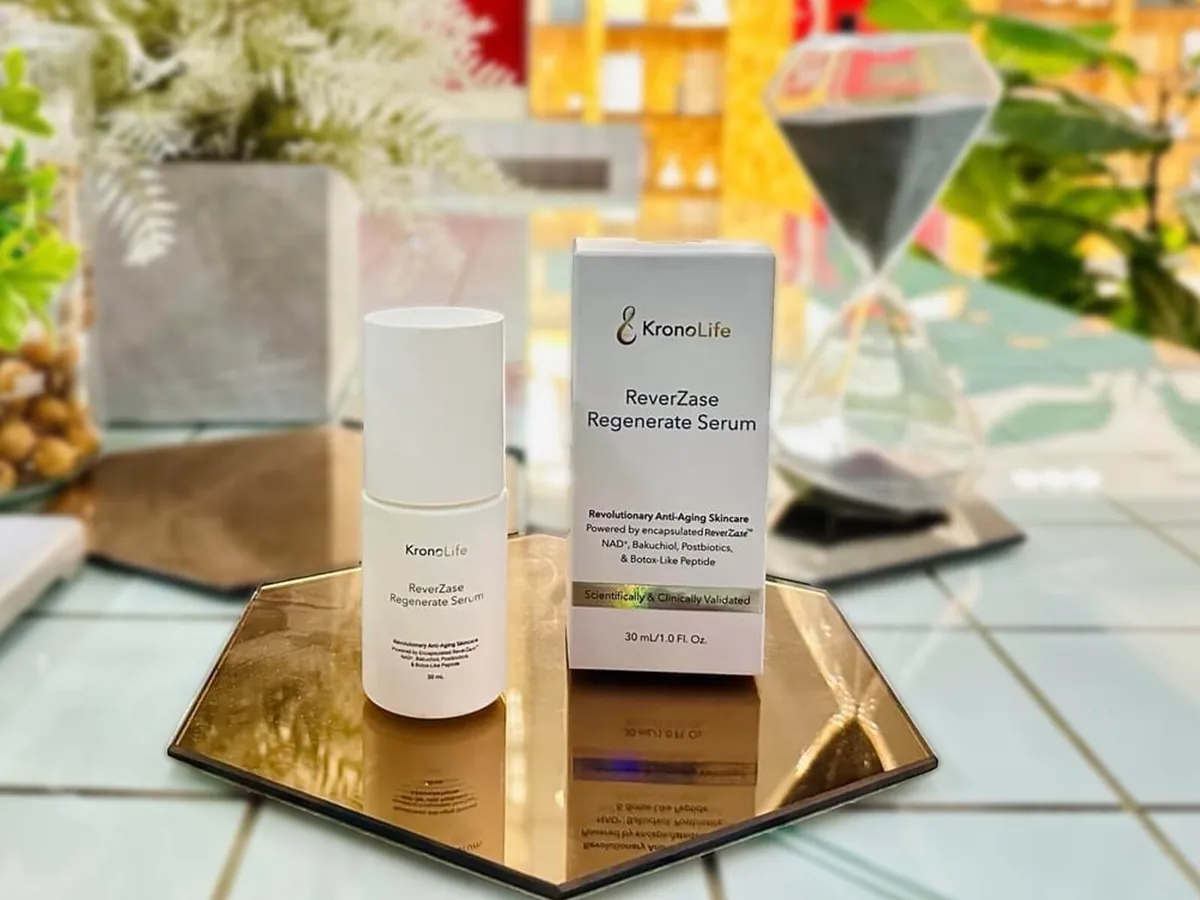
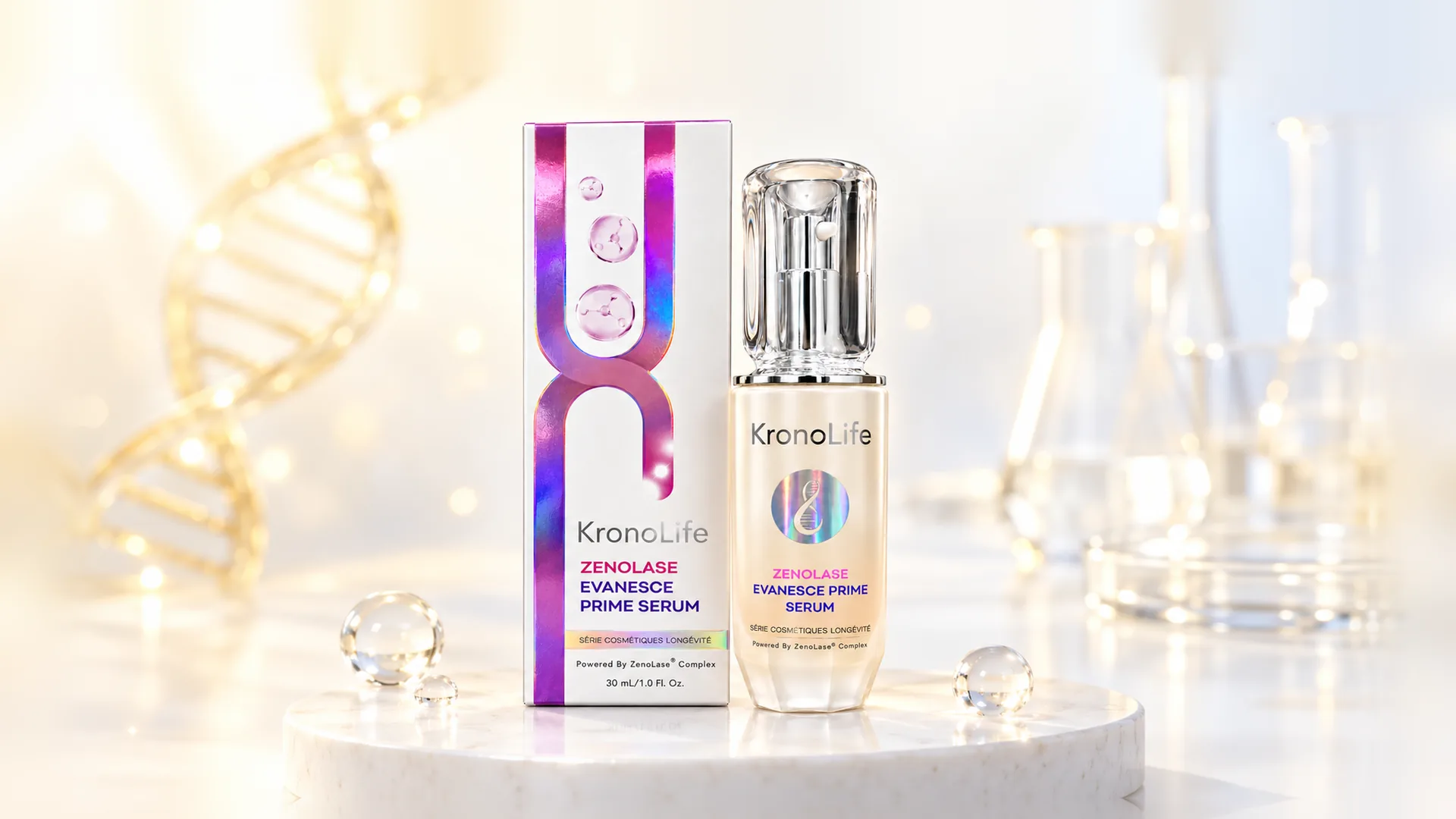
KronoLife offers four plant-derived longevity actives for licensing: ZenoLase, a topical senolytic; ReverZase, a topical senomorphic; DionySenz, an oral senolytic for supplements; and the KronoZase complex, an oral geroprotector. Specifications, evidence summaries and evaluation samples are available for each active, and the plant sources are confidential.
If these terms are new, the guide to senolytics, senomorphics and geroprotectors explains how they differ. All figures below are KronoLife internal data, each reported with the model used.
| Active | Type | Format | Selected internal data |
|---|---|---|---|
| ZenoLase | Senolytic; high-purity plant extract; patent pending | Topical | Ex vivo adult human skin vs control: senolytic activity +255%, collagen +94%, hyaluronic acid +484%, age-related inflammation −40 to −55%. Clinical: non-irritating, non-sensitizing. |
| ReverZase | Senomorphic; plant extract | Topical | Cell models (HDFa, THP-1): about 75% reversal of senescence markers. Ex vivo aged skin: collagen +103%, less DNA damage. 3D pigmented skin (15 days): melanin −59%. Clinical: non-irritating. |
| DionySenz | Senolytic for supplements | Oral | Ex vivo aged human skin: about 60% reduction in senescent cells, comparable to navitoclax and dasatinib plus quercetin used as laboratory reference senolytics. Clinical: 10 days of oral intake improved skin hydration and radiance with no side effects. |
| KronoZase complex | Geroprotector | Oral | HDFa cells and ex vivo skin: higher intracellular NAD+, lower inflammation and ROS, support for collagen and hyaluronic acid. Significantly extended the lifespan of C. elegans. |
The ZenoLase senolytic serum case study follows one of these actives from ex vivo data to a finished serum on the market in Thailand, including the clinical results at 14 days. Specifications and evaluation samples for each active are available through the KronoLife actives page. Brands that want a finished longevity product rather than an ingredient can look at co-development of finished products instead.
Five common mistakes in active ingredient licensing
Five common mistakes in active ingredient licensing are choosing an active on headline percentages, testing only the raw active, picking the IP model last, writing claims before the claim-to-data map, and underestimating study lead times. All five can be checked and avoided before an agreement is signed.
- Choosing on headline percentages. A large number from a cell assay and a smaller number from ex vivo human skin are not comparable. Ask for the model and the control first.
- Testing only the raw active. The finished formula decides what the consumer experiences. Budget time for at least one confirmation study.
- Picking the IP model last. Decide early what your company wants to own in five years. That answer usually points to one of the three models.
- Writing claims before the data map. Marketing copy written first tends to stretch the evidence. Build the claim-to-data map, then write.
- Underestimating lead times. Specialist markers and reagent ordering can add time, and the schedule for each study is set out in the project quotation. Plan studies before the launch date is fixed.
The practical next step is simple: request an evaluation sample and the evidence summary for the active that fits your product, and run your own compatibility work while the agreement is discussed.
FAQ
What is the difference between a license and co-development?
A license gives the partner rights to an existing active, while co-development creates something new that both sides own. In a license, the developer keeps the IP and the partner uses an existing, documented active. In co-development, both sides create something new together, such as a new delivery form or evidence for a new use, and the resulting IP is jointly owned.
Is safety data available before we start production?
Yes. ZenoLase was non-irritating and non-sensitizing in clinical testing, and ReverZase was non-irritating. A finished formula can also be screened on ex vivo human skin for viability and cumulative irritation before production.
How long does it take from evaluation sample to launch?
The time from evaluation sample to launch depends on how much new work your claims require. If the existing dossier covers your claims, the main steps are formulation, stability and compatibility. If you need a new ex vivo study on your finished formula, its timing depends on the markers chosen, including reagent ordering, and is set out in the project quotation.
Do you disclose the plant source of the actives?
No. The plant sources of KronoLife actives are confidential. Partners receive the specification, safety information and evidence summary needed to evaluate and formulate the active.
Can co-development cover an oral supplement format?
Yes. The KronoLife portfolio includes two oral actives, DionySenz and the KronoZase complex. Supplements can also be tested on ex vivo human skin using systemic-style exposure, which few laboratories offer.
References
- Klinngam W, Chaiwichien A, Osotprasit S, Ruktanonchai U, Kanlayavattanakul M, Lourith N, Wongrakpanich A, Teeranachaideekul V, Iempridee T. Longevity cosmeceuticals as the next frontier in cosmetic innovation: a scientific framework for substantiating product claims. Front Aging. 2025;6:1586999. doi:10.3389/fragi.2025.1586999
- López-Otín C, Blasco MA, Partridge L, Serrano M, Kroemer G. Hallmarks of aging: an expanding universe. Cell. 2023;186(2):243-278. doi:10.1016/j.cell.2022.11.001
- Klinngam W, Rungkamoltip P, Wongwanakul R, Joothamongkhon J, Du-A-Man S, Khongkow M, Asawapirom U, Iempridee T, Ruktanonchai U. Skin rejuvenation efficacy and safety evaluation of Kaempferia parviflora standardized extract (BG100) in human 3D skin models and clinical trial. Biomolecules. 2024;14(7):776. doi:10.3390/biom14070776
- Eberlin S, da Silva MS, Facchini G, da Silva GH, Pinheiro ALTA, Eberlin S, Pinheiro ADS. The ex vivo skin model as an alternative tool for the efficacy and safety evaluation of topical products. Altern Lab Anim. 2020;48(1):10-22. doi:10.1177/0261192920914193
- Scientific Committee on Consumer Safety (SCCS). The SCCS Notes of Guidance for the testing of cosmetic ingredients and their safety evaluation, 11th revision, 30-31 March 2021, SCCS/1628/21. Regul Toxicol Pharmacol. 2021;127:105052. doi:10.1016/j.yrtph.2021.105052
- Kanlayavattanakul M, Khongkow M, Klinngam W, Chaikul P, Lourith N, Chueamchaitrakun P. Recent insights into catechins-rich Assam tea extract for photoaging and senescent ageing. Sci Rep. 2024;14(1):2253. doi:10.1038/s41598-024-52781-2
Longevity actives
Evaluate a patented longevity active
Ask for the technical dossier of ZenoLase, ReverZase, DionySenz or KronoZase: mechanism, efficacy by model, safety and recommended use level.

About KronoLife's scientific lead
Dr. Tawin Iempridee is Co-Founder and CEO–CTO of KronoLife, with a Ph.D. in Cancer Biology from the University of Wisconsin–Madison and a research focus on the biology of aging. Dr. Tawin has 25+ international publications and 17+ IP filings, and is senior author of a 2025 framework for substantiating longevity cosmeceutical claims.
About KronoLifeRelated reading
From Lab to Paris: Building and Testing the ZenoLase Senolytic Serum
A case study for brands and ingredient buyers. How a patent-pending senolytic active moved from aged human skin cells to ex vivo human skin, a finished serum, clinical use testing and a Top 3 place at Cosmetic Victories 2023 in Paris.
Read the articleSenolytics, Senomorphics and Geroprotectors: A Formulator's Guide
Three classes of longevity actives act on aging biology in different ways. This guide explains how each works, what changes when research drugs become consumer products, and how to choose a class for a brief.
Read the article
Senescent Cells in Skin Aging: What R&D Teams Need to Know
Cellular senescence links UV, DNA damage and time to collagen loss, chronic inflammation and uneven pigment. This guide covers the biology, the human-skin evidence, and what it means for actives, endpoints and claims.
Read the article