
Guide
Senolytics, Senomorphics and Geroprotectors: A Formulator's Guide
Three classes of longevity actives act on aging biology in different ways. This guide explains how each works, what changes when research drugs become consumer products, and how to choose a class for a brief.
Senolytics are compounds that selectively remove senescent cells, the damaged, non-dividing cells that accumulate with age and release inflammatory signals. Interest has spread from aging research into supplements and skincare, and search interest in "senolytic drugs" has risen sharply. Formulators now face briefs that mix three terms: senolytics, senomorphics and geroprotectors. They describe different mechanisms, need different evidence and support different claims.
This guide is for R&D and formulation teams who need to know what each class does, which research compounds define it, and what changes when a molecule that worked in mice has to work in a serum or a capsule. It ends with a comparison table and a map of KronoLife's actives to the three classes.
If you need the underlying biology first, start with Senescent Cells in Skin Aging: What R&D Teams Need to Know.
What is the difference between senolytics, senomorphics and geroprotectors?
Senolytics selectively push senescent cells into apoptosis, senomorphics suppress the senescence-associated secretory phenotype (SASP) and other senescence features without killing the cell, and geroprotectors are a broader class of compounds shown to extend healthspan or lifespan in animal models. Senolytics and senomorphics are both senotherapeutics, meaning compounds that act on senescent cells.
Senescent cells up-regulate senescent-cell anti-apoptotic pathways (SCAPs) that keep them alive despite accumulated damage. Compounds that exploit these pathways to induce selective death of senescent cells are termed senolytics. Compounds that suppress markers of senescence, in particular the SASP, without killing the cell are termed senomorphics.[1]
Geroprotectors are a wider group. The term covers compounds capable of extending healthspan and lifespan in animal models. A 2025 framework for longevity cosmeceuticals builds on this idea and proposes that a longevity active should target established hallmarks of skin aging and extend "skinspan", meaning skin viability, structure and function over time.[2]
Cellular senescence is one of twelve hallmarks of aging; others include genomic instability, telomere attrition, mitochondrial dysfunction, deregulated nutrient sensing and chronic inflammation.[3] A geroprotector can act on any of them, so every senolytic with healthspan data is a geroprotector, but not every geroprotector is a senolytic.
In short:
- Senolytic: fewer senescent cells.
- Senomorphic: the same senescent cells, sending fewer harmful signals.
- Geroprotector: less of the damage that drives aging, by any of several mechanisms, with evidence of extended healthspan or lifespan in a model organism.
How do senolytics work?
Senolytics such as dasatinib plus quercetin, navitoclax and fisetin work by temporarily disabling senescent-cell anti-apoptotic pathways (SCAPs), the pro-survival networks that keep damaged senescent cells alive, including BCL-2 family proteins. With these pathways blocked, senescent cells undergo apoptosis, while proliferating and quiescent cells are spared.
The first senolytics were not found by random screening. Researchers compared gene expression in senescent and non-senescent human cells and found that senescent cells up-regulate pro-survival networks, consistent with their known resistance to apoptosis. Silencing key nodes of these networks, including ephrins, PI3Kδ, p21, BCL-xL and plasminogen activator inhibitor-2, killed senescent cells but not proliferating or quiescent cells.[4]
Dasatinib plus quercetin
Drugs aimed at the same nodes did the same. Dasatinib, a kinase inhibitor used in oncology, eliminated senescent human fat cell progenitors. Quercetin, a plant flavonol, was more effective against senescent human endothelial cells. The combination cleared senescent mouse embryonic fibroblasts, reduced senescent cell burden in aged, irradiated and progeroid mice, and improved cardiac function in old mice 5 days after a single dose.[4]
Intermittent oral dasatinib plus quercetin later improved physical function in aged mice and increased survival measured after the dosing period by 36%.[5]
Navitoclax
Navitoclax (ABT-263) inhibits BCL-2, BCL-xL and BCL-w. It was senolytic in senescent human umbilical vein endothelial cells, IMR90 lung fibroblasts and mouse embryonic fibroblasts, but not in human primary preadipocytes. Susceptibility tracked the pattern of BCL-2 family proteins in each senescent cell type.[6] The lesson for product work is that a senolytic result in one cell type does not predict a result in another.
Fisetin
Fisetin is a flavonoid found in many fruits and vegetables. It selectively induced apoptosis in senescent human endothelial cells but was not senolytic in senescent IMR90 fibroblasts or preadipocytes.[7]
In a screen of 10 flavonoids, fisetin was the most potent senolytic. Given to wild-type mice late in life, it reduced senescence markers, reduced age-related pathology and extended median and maximum lifespan. In human adipose tissue explants it reduced senescence in a subset of cells.[8] Plant-derived senolytics are covered in more detail in Natural Senolytics: Plant Compounds and the Evidence Behind Them.
Hit-and-run dosing
Because senescent cells take weeks to reaccumulate, senolytics can be given intermittently. This "hit-and-run" approach transiently disables SCAPs, triggers apoptosis of senescent cells with a tissue-destructive SASP, and then stops.[9] In a human pilot study, dasatinib and quercetin had elimination half-lives under 11 hours, yet senescent cell markers were still lower 11 days after a 3-day course.[10] Intermittent dosing reduces total exposure, which is one of the main safety arguments for the senolytic approach.
Have senolytic drugs been tested in humans?
Senolytic drugs have been tested in humans, but the first trials were small pilot studies in people with disease. Dasatinib plus quercetin, given in short courses, was studied in 14 people with idiopathic pulmonary fibrosis and 9 people with diabetic kidney disease, and no senolytic is approved for aging. Senolytic therapy is a medical research field.
- Idiopathic pulmonary fibrosis. In the first-in-human, open-label pilot, 14 people with idiopathic pulmonary fibrosis took dasatinib 100 mg/day and quercetin 1,250 mg/day, three days a week for three weeks. Retention was 100%, and physical function measures such as 6-minute walk distance and gait speed improved. Respiratory symptoms, skin irritation or bruising, and gastrointestinal discomfort were the most frequent non-serious events, and one serious adverse event was reported.[11]
- Diabetic kidney disease. Nine people with diabetic kidney disease took dasatinib 100 mg and quercetin 1,000 mg for 3 days. Eleven days later, senescent cells in adipose tissue were reduced, p16- and p21-positive cells in the skin epidermis were reduced, and circulating SASP factors including IL-1α, IL-6, MMP-9 and MMP-12 were lower.[10]
Researchers who developed these compounds have stated that, until controlled trials are completed, it is too early for senolytics to be used outside clinical trials.[9] Later reviews describe a growing pipeline of trials and new senescence-targeting strategies, but still frame senolytics as an investigational medical approach.[12]
Safety is the other half of the story. In a phase 1 study of navitoclax in lymphoid cancers, grade 3 or 4 thrombocytopenia occurred in 29 of 55 patients, explained by high-affinity inhibition of BCL-xL, which platelets depend on.[13] This toxicity is one reason researchers looked for alternatives, such as fisetin, described as a naturally occurring flavone with low toxicity, and BCL-xL inhibitors that may have less hematological toxicity than navitoclax.[7]
For a consumer product, none of these outcomes can be borrowed. A cosmetic or supplement active must stand on its own data, at its own dose, in its own format.
How do senomorphics work without killing cells?
Senomorphics are compounds that suppress the senescence-associated secretory phenotype (SASP), the inflammatory cytokines and proteases that senescent cells release, while leaving the cells alive. Two drug examples show the mechanisms most often targeted: mTOR inhibition by rapamycin and blocking of NF-κB signaling by metformin. Senomorphics leave senescent cells in place but change what they secrete.
- Rapamycin (mTOR inhibition). Rapamycin suppressed the secretion of inflammatory cytokines by senescent cells. It lowered IL-6 and other cytokine mRNAs and selectively suppressed translation of IL-1α, which reduced NF-κB activity, the transcriptional driver of much of the SASP.[14]
- Metformin (NF-κB signaling). Metformin inhibited the expression of genes coding for multiple inflammatory cytokines in senescent cells by blocking activation of the NF-κB pathway.[15]
Skin data exist for both drugs and cosmetic ingredients. In an exploratory randomized trial of topical rapamycin in adults over 40, p16INK4a protein in skin decreased and collagen VII increased, although more than half of participants did not complete the study.[16] In cosmetic research, a formula of niacinamide and hyaluronic acid increased collagen and glycosaminoglycans in ex vivo skin explants, improved fine lines and other appearance measures in 44 women over two months, and, in skin biopsies from a separate group of 30 women, lowered the expression of SASP genes including MMP12, CXCL9, S100A8 and S100A9.[17] That study is a useful template for how a senomorphic claim can be measured in human skin.
Plant compounds can be senomorphic too. Polymethoxyflavones from Kaempferia parviflora suppressed senescence, ROS and the SASP in primary human dermal fibroblasts and attenuated senescence in ex vivo human skin.[18] Some compounds cross between classes: procyanidin C1 inhibited SASP formation at low concentrations and selectively killed senescent cells at higher ones.[19]
The practical difference from senolytics is the use pattern. Because senomorphics do not remove the senescent cells, the benefit probably depends on continued exposure. That fits daily-use products well, and it lowers the safety bar compared with a compound designed to induce cell death.
What is a geroprotector?
A geroprotector is a compound shown to extend healthspan or lifespan in animal models, by any mechanism. A geroprotector does not have to touch senescent cells at all: it can act on mitochondrial function, nutrient sensing, DNA repair, proteostasis or inflammation. For skincare and supplements, geroprotection means protecting cells from the damage that leads to senescence and dysfunction, and measuring that protection with hallmark-based markers.[2]
NAD+ biology is a common geroprotector target: NAD+ is a coenzyme for redox reactions and a cofactor for sirtuins, CD38 and poly(ADP-ribose) polymerases, and it influences metabolism, DNA repair and cellular senescence. Tissue and cellular NAD+ levels decline with age in several model organisms, including rodents and humans. The same review notes that whether NAD+ repletion is safe and beneficial in aging humans still has to be established.[20] That caveat belongs in any NAD+-based brief.
Lifespan models are what separate a geroprotector from a general antioxidant. The nematode C. elegans is a common first screen because its lifespan is a few weeks, followed by mouse studies for the strongest candidates. For a consumer product, a lifespan result in a model organism is supporting mechanism evidence. The claim itself should rest on skin or human-use endpoints.
Senolytics vs senomorphics vs geroprotectors: how do they compare?
Senolytics, senomorphics and geroprotectors differ in goal, dosing and risk. Senolytics aim for fewer senescent cells and suit intermittent dosing; senomorphics reduce harmful output from senescent cells and need continuous exposure; geroprotectors reduce aging damage across hallmarks, with evidence of longer healthspan in model organisms. The table sets out mechanism, research examples, key measurements, main risks and a consumer claim pattern for each class.
| Senolytics | Senomorphics | Geroprotectors | |
|---|---|---|---|
| Goal | Fewer senescent cells | Less harmful output from senescent cells | Less aging damage across hallmarks; longer healthspan in models |
| Main mechanism | Disable SCAPs such as BCL-2 family proteins, triggering apoptosis in senescent cells | Suppress SASP signaling, for example through mTOR or NF-κB | Varies: NAD+ support, mitochondrial protection, DNA protection, anti-inflammatory action |
| Research examples | Dasatinib plus quercetin, navitoclax, fisetin | Rapamycin, metformin, some flavonoids | Compounds with lifespan or healthspan data in model organisms |
| Dosing logic | Intermittent, "hit-and-run" | Continuous | Continuous |
| Key measurements | SA-β-gal, p16INK4a, p21 counts; apoptosis selectivity versus non-senescent cells | IL-6, IL-8, MMP-1 and other SASP factors; collagen and HA recovery | NAD+, ROS, DNA damage, mitochondrial function, lifespan in model organisms |
| Main risks | Off-target cell death; transient inflammation; for drugs, low platelet counts | Effect ends when exposure ends; broad anti-inflammatory effects | Weak link between model lifespan and skin outcomes |
| Consumer claim pattern | "Reduced senescent cell markers in [named model]" | "Reduced age-related inflammatory markers in [named model]" | "Protected [named model] against [stressor]; supported [marker]" |
What changes when a senolytic drug becomes a consumer product?
Six things change when a senolytic drug concept becomes a topical or oral consumer product: selectivity must be shown in skin cells, the dose window must be mapped, intermittent dosing must fit daily routines, a topical active must penetrate skin, safety standards become stricter, and measurement moves to human-relevant models. Most senolytic research uses drugs in animals or patients.
1. Selectivity has to be shown in relevant cells
Senolytics are cell-type restricted.[6][7] A compound that clears senescent endothelial cells may do nothing to senescent dermal fibroblasts. For skin, the relevant cells are dermal fibroblasts, keratinocytes and melanocytes, and the test should include non-senescent cells of the same type so that a selectivity ratio can be reported.
2. The dose window is narrower than it looks
The human pilot trials used 100 mg of dasatinib with 1,000 to 1,250 mg of quercetin per day.[11][10] Those are pharmacological doses, not supplement or cosmetic ones. Many compounds also change class with concentration, from senomorphic at low dose to senolytic at higher dose.[19] A consumer active needs its own concentration-response curve in senescent and non-senescent human cells, and the finished formula should deliver a concentration inside the selective range.
3. Intermittent dosing meets daily routines
Senolytic logic favors short courses with long gaps.[9] Consumer routines are daily. Product teams can resolve this by choosing actives with a wide safety margin for daily use, by pairing a senolytic with a senomorphic or protective ingredient, or by designing a course-based regimen. Whatever the choice, the study protocol should use the same pattern as the label.
4. Skin penetration and local reactions
A topical senolytic must reach senescent cells in the epidermis and dermis. In aged mice, topical ABT-263 applied for 5 days lowered p16 and p21 expression and reduced SA-β-gal- and p21-positive cells, but it also triggered a temporary inflammatory response and macrophage infiltration.[21] Clearing senescent cells in skin may therefore come with a short inflammatory phase, and studies should measure inflammation and tolerance alongside senescence markers. Delivery systems such as encapsulation change penetration, so the encapsulated form is the one to test.
5. Safety standards are different
Drug trials accept side effects that a consumer product cannot. Skin irritation and bruising were among the most frequent non-serious events with oral dasatinib plus quercetin in the pulmonary fibrosis pilot.[11] A cosmetic active needs irritation, sensitization and genotoxicity data, and the finished product needs clinical tolerance testing. A supplement active needs data on oral intake at the labeled dose.
6. Measurement moves to human-relevant models
Mouse lifespan cannot support a skin claim. The evidence has to come from human cells, 3D skin models, ex vivo human skin and human-use studies, with post-trial biopsies where the claim is about aging biomarkers.[2] The niacinamide and hyaluronic acid study is one example of linking a senomorphic gene signature in biopsies to visible clinical change.[17]
Which KronoLife actives are senolytics, senomorphics or geroprotectors?
KronoLife's four plant-derived actives cover all three classes: ZenoLase is a topical senolytic, DionySenz is an oral senolytic for supplements, ReverZase is a topical senomorphic, and the KronoZase complex is an oral geroprotector. Each has KronoLife internal data in named models. They were developed to cover both topical and oral formats, and the plant sources are confidential. The results below are KronoLife internal data, with the model named for each.
| Active | Class | Format | Models | Key results |
|---|---|---|---|---|
| ZenoLase | Senolytic | Topical (skincare) | Ex vivo adult human skin; aged human skin cells; 3D skin; clinical patch testing | Ex vivo: senolytic activity +255% vs control, collagen +94%, HA +484%, age-related inflammation −40 to −55%. Aged skin cells: 60% mitochondrial protection. 3D skin: melanin −38%. Clinical: non-irritating, non-sensitizing. |
| DionySenz | Senolytic | Oral (supplement) | Ex vivo aged human skin; clinical use | Ex vivo: about 60% senescent-cell reduction, in the same range as navitoclax and dasatinib plus quercetin run as lab comparators; lower pigmentation, inflammation and ROS. Clinical: 10 days of oral intake improved skin hydration and radiance, with no side effects reported. |
| ReverZase | Senomorphic | Topical (skincare) | HDFa fibroblasts and THP-1 cells; ex vivo aged human skin; 3D pigmented skin (15 days); clinical patch testing | Cells: about 75% reversal of senescence markers, lower age-related inflammation, restored mitochondria. Ex vivo: less DNA damage, collagen +103%, more HA. 3D pigmented skin: melanin −59%. Clinical: non-irritating. |
| KronoZase complex | Geroprotector | Oral (supplement) | HDFa cells; ex vivo skin; B16F10 cells; C. elegans | Raised intracellular NAD+, lowered inflammation and ROS, supported mitochondria, collagen and HA. Less melanin in B16F10 cells. Significantly extended C. elegans lifespan. |
The DionySenz comparator result describes activity in an ex vivo model next to reference compounds. It is a benchmarking result, not a claim of drug-like effects in people.
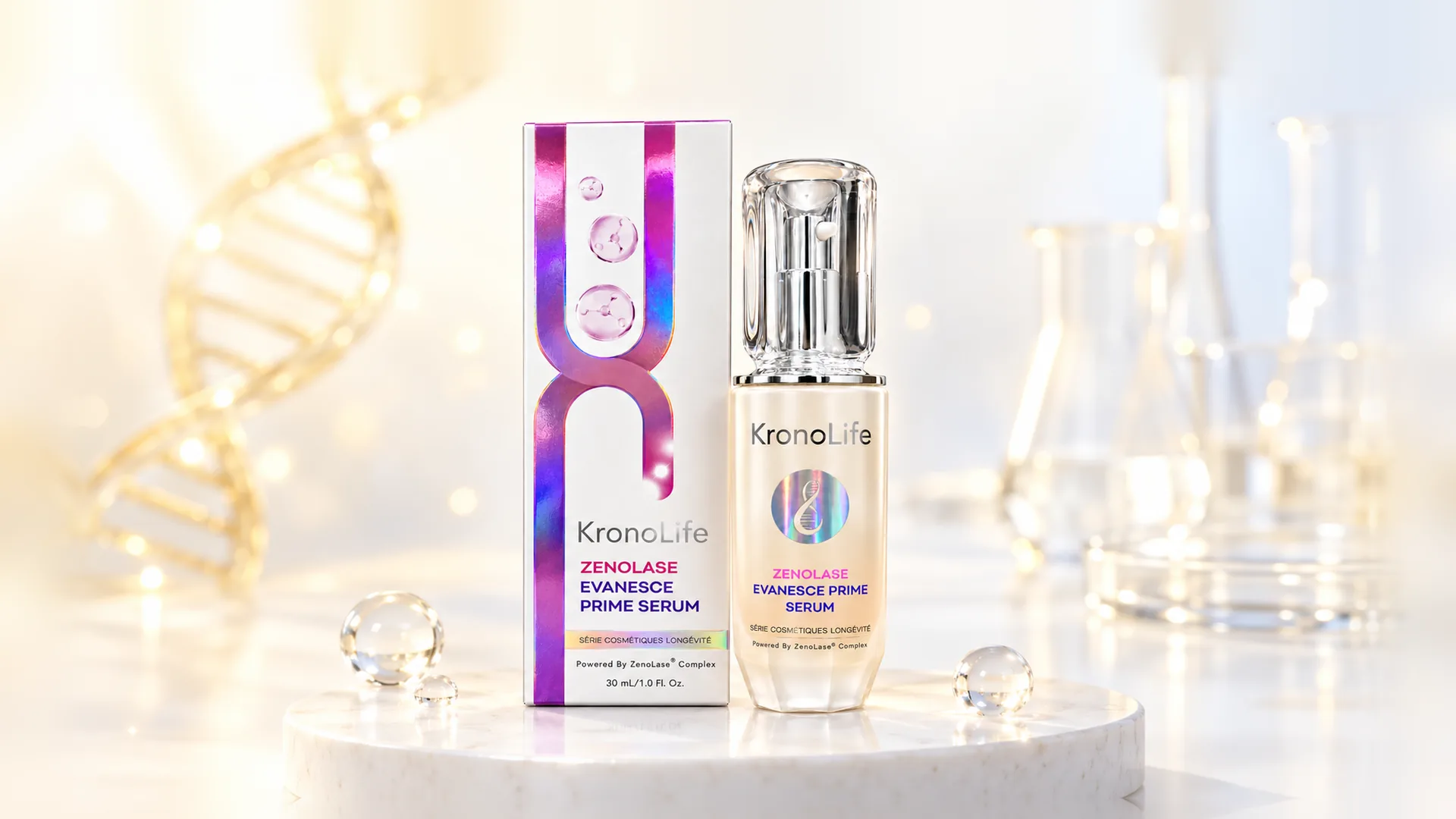
Two finished serums show how the actives perform in a formula. ZenoLase Evanesce Prime Serum combines ZenoLase encapsulated in Liponiosome nanoparticles with triplex peptides. In KronoLife internal data it showed senolytic activity +158% and age-related inflammation −50 to −85% on ex vivo human skin, with protection against UV, blue light and PM2.5 stressors; telomere length restored 2× versus control in a 3D skin model; and improved hydration, elasticity, radiance and fine lines within 14 days in a clinical study, where it was non-irritating and hypoallergenic. It was a Top 3 finalist at Cosmetic Victories 2023 and is on the market in Thailand.
ReverZase Regenerate Serum combines EN-ReverZase-NAD+ in Liponiosome with postbiotics, bakuchiol, an anti-wrinkle peptide and skin boosters; clinical data showed improved hydration, elasticity and fine lines at 14 days and radiance at 28 days. It received a Bronze Medal at the 49th Geneva International Exhibition of Inventions in 2024.
On the oral side, a longer clinical trial of improved tablet forms, ZenoBlazt+ with ZenoGenez+, is running with a Thai university faculty of medicine. Its endpoints include safety, sleep quality, quality of life, skin, inflammation, blood telomere length and biological age. Results have not been published.
How do you choose between a senolytic, a senomorphic and a geroprotector?
The choice between a senolytic, a senomorphic and a geroprotector follows from four questions: what the claim will say, which format the product uses, how often it will be used, and how much evidence the team can build. Daily-use products favor senomorphic and geroprotective actives, or senolytics with a wide safety margin, while course-based regimens suit senolytics.
- What will the claim say? If the claim is about senescent cell markers, you need a senolytic or senomorphic with marker data in a named skin model. If the claim is about protection against stressors, a geroprotector or protective active may be enough.
- What is the format? Topical actives need penetration and tolerance data on skin. Oral actives need bioavailability logic and tolerability at the labeled dose. Supplements can be tested on ex vivo skin with systemic-style exposure, which lets an oral active show an effect in skin tissue.
- What is the use pattern? Daily use favors senomorphic and geroprotective actives, or senolytics with a wide safety margin. Course-based regimens suit senolytics.
- How much evidence can you build? A licensed active with existing data in human-relevant models shortens development. A new active needs the full path from mechanism to human use.
Many longevity formulas combine classes: a senolytic to lower senescent cell numbers, a senomorphic to quiet what remains and a protective ingredient to slow new senescence. ReverZase Regenerate Serum, for example, pairs a senomorphic active with NAD+ in one delivery system. A side-by-side view of individual ingredients is in Longevity Ingredients Compared.
KronoLife offers its actives through three partnership models: a license in which KronoLife keeps the IP, co-development with joint IP, and transfer with license-back. How these work in practice is explained in our guide to licensing a patented longevity active. To discuss a specific brief, start from the KronoLife actives page.
FAQ
Are senolytics drugs or cosmetic ingredients?
Both exist. Dasatinib and navitoclax are drugs developed for cancer, while quercetin and fisetin are plant compounds. In a cosmetic or supplement, "senolytic" describes an activity measured in a named model, not a medical effect.
Is senolytic therapy approved for aging?
No senolytic is approved for aging. Small pilot trials have tested senolytic drugs in disease settings, and the researchers who developed them advise against use outside clinical trials until controlled results are available.
Can a senolytic and a senomorphic be used in the same formula?
Yes. They act on different parts of the problem: one lowers senescent cell numbers, the other lowers the signals from cells that remain. Test the combination as a finished formula, because penetration and stability can change when actives are combined.
How is a geroprotector different from an antioxidant?
A geroprotector is defined by an outcome, extended healthspan or lifespan in a model organism, while an antioxidant is defined by a chemical property. Some antioxidants qualify as geroprotectors, but many do not.
Which models are most credible for a senolytic skin claim?
Ex vivo human skin from adult donors and full-thickness 3D skin models are the most credible models. A strong package measures at least two senescence markers, a SASP readout and safety data in those models, followed by a human-use study. Cell data alone show mechanism but not a skin effect.
References
- Zhang L, Pitcher LE, Prahalad V, Niedernhofer LJ, Robbins PD. Targeting cellular senescence with senotherapeutics: senolytics and senomorphics. FEBS J. 2023;290(5):1362-1383. doi:10.1111/febs.16350
- Klinngam W, Chaiwichien A, Osotprasit S, Ruktanonchai U, Kanlayavattanakul M, Lourith N, Wongrakpanich A, Teeranachaideekul V, Iempridee T. Longevity cosmeceuticals as the next frontier in cosmetic innovation: a scientific framework for substantiating product claims. Front Aging. 2025;6:1586999. doi:10.3389/fragi.2025.1586999
- López-Otín C, Blasco MA, Partridge L, Serrano M, Kroemer G. Hallmarks of aging: An expanding universe. Cell. 2023;186(2):243-278. doi:10.1016/j.cell.2022.11.001
- Zhu Y, Tchkonia T, Pirtskhalava T, Gower AC, Ding H, Giorgadze N, et al. The Achilles' heel of senescent cells: from transcriptome to senolytic drugs. Aging Cell. 2015;14(4):644-58. doi:10.1111/acel.12344
- Xu M, Pirtskhalava T, Farr JN, Weigand BM, Palmer AK, Weivoda MM, et al. Senolytics improve physical function and increase lifespan in old age. Nat Med. 2018;24(8):1246-1256. doi:10.1038/s41591-018-0092-9
- Zhu Y, Tchkonia T, Fuhrmann-Stroissnigg H, Dai HM, Ling YY, Stout MB, et al. Identification of a novel senolytic agent, navitoclax, targeting the Bcl-2 family of anti-apoptotic factors. Aging Cell. 2016;15(3):428-35. doi:10.1111/acel.12445
- Zhu Y, Doornebal EJ, Pirtskhalava T, Giorgadze N, Wentworth M, Fuhrmann-Stroissnigg H, et al. New agents that target senescent cells: the flavone, fisetin, and the BCL-XL inhibitors, A1331852 and A1155463. Aging (Albany NY). 2017;9(3):955-963. doi:10.18632/aging.101202
- Yousefzadeh MJ, Zhu Y, McGowan SJ, Angelini L, Fuhrmann-Stroissnigg H, Xu M, et al. Fisetin is a senotherapeutic that extends health and lifespan. EBioMedicine. 2018;36:18-28. doi:10.1016/j.ebiom.2018.09.015
- Kirkland JL, Tchkonia T. Senolytic drugs: from discovery to translation. J Intern Med. 2020;288(5):518-536. doi:10.1111/joim.13141
- Hickson LJ, Langhi Prata LGP, Bobart SA, Evans TK, Giorgadze N, Hashmi SK, et al. Senolytics decrease senescent cells in humans: Preliminary report from a clinical trial of Dasatinib plus Quercetin in individuals with diabetic kidney disease. EBioMedicine. 2019;47:446-456. doi:10.1016/j.ebiom.2019.08.069
- Justice JN, Nambiar AM, Tchkonia T, LeBrasseur NK, Pascual R, Hashmi SK, et al. Senolytics in idiopathic pulmonary fibrosis: Results from a first-in-human, open-label, pilot study. EBioMedicine. 2019;40:554-563. doi:10.1016/j.ebiom.2018.12.052
- Chaib S, Tchkonia T, Kirkland JL. Cellular senescence and senolytics: the path to the clinic. Nat Med. 2022;28(8):1556-1568. doi:10.1038/s41591-022-01923-y
- Wilson WH, O'Connor OA, Czuczman MS, LaCasce AS, Gerecitano JF, Leonard JP, et al. Navitoclax, a targeted high-affinity inhibitor of BCL-2, in lymphoid malignancies: a phase 1 dose-escalation study of safety, pharmacokinetics, pharmacodynamics, and antitumour activity. Lancet Oncol. 2010;11(12):1149-59. doi:10.1016/S1470-2045(10)70261-8
- Laberge RM, Sun Y, Orjalo AV, Patil CK, Freund A, Zhou L, et al. MTOR regulates the pro-tumorigenic senescence-associated secretory phenotype by promoting IL1A translation. Nat Cell Biol. 2015;17(8):1049-61. doi:10.1038/ncb3195
- Moiseeva O, Deschênes-Simard X, St-Germain E, Igelmann S, Huot G, Cadar AE, et al. Metformin inhibits the senescence-associated secretory phenotype by interfering with IKK/NF-κB activation. Aging Cell. 2013;12(3):489-98. doi:10.1111/acel.12075
- Chung CL, Lawrence I, Hoffman M, Elgindi D, Nadhan K, Potnis M, et al. Topical rapamycin reduces markers of senescence and aging in human skin: an exploratory, prospective, randomized trial. Geroscience. 2019;41(6):861-869. doi:10.1007/s11357-019-00113-y
- Bogdanowicz P, Bensadoun P, Noizet M, Béganton B, Philippe A, Alvarez-Georges S, et al. Senomorphic activity of a combination of niacinamide and hyaluronic acid: correlation with clinical improvement of skin aging. Sci Rep. 2024;14(1):16321. doi:10.1038/s41598-024-66624-7
- Klinngam W, Rungkamoltip P, Thongin S, Joothamongkhon J, Khumkhrong P, Khongkow M, Namdee K, Tepaamorndech S, Chaikul P, Kanlayavattanakul M, Lourith N, Piboonprai K, Ruktanonchai U, Asawapirom U, Iempridee T. Polymethoxyflavones from Kaempferia parviflora ameliorate skin aging in primary human dermal fibroblasts and ex vivo human skin. Biomed Pharmacother. 2022;145:112461. doi:10.1016/j.biopha.2021.112461
- Xu Q, Fu Q, Li Z, Liu H, Wang Y, Lin X, et al. The flavonoid procyanidin C1 has senotherapeutic activity and increases lifespan in mice. Nat Metab. 2021;3(12):1706-1726. doi:10.1038/s42255-021-00491-8
- Covarrubias AJ, Perrone R, Grozio A, Verdin E. NAD+ metabolism and its roles in cellular processes during ageing. Nat Rev Mol Cell Biol. 2021;22(2):119-141. doi:10.1038/s41580-020-00313-x
- Shvedova M, Thanapaul RJRS, Ha J, Dhillon J, Shin GH, Crouch J, et al. Topical ABT-263 treatment reduces aged skin senescence and improves subsequent wound healing. Aging (Albany NY). 2024;17(1):16-32. doi:10.18632/aging.206165
Longevity actives
Evaluate a patented longevity active
Ask for the technical dossier of ZenoLase, ReverZase, DionySenz or KronoZase: mechanism, efficacy by model, safety and recommended use level.

About KronoLife's scientific lead
Dr. Tawin Iempridee is Co-Founder and CEO–CTO of KronoLife, with a Ph.D. in Cancer Biology from the University of Wisconsin–Madison and a research focus on the biology of aging. Dr. Tawin has 25+ international publications and 17+ IP filings, and is senior author of a 2025 framework for substantiating longevity cosmeceutical claims.
About KronoLifeRelated reading
From Lab to Paris: Building and Testing the ZenoLase Senolytic Serum
A case study for brands and ingredient buyers. How a patent-pending senolytic active moved from aged human skin cells to ex vivo human skin, a finished serum, clinical use testing and a Top 3 place at Cosmetic Victories 2023 in Paris.
Read the article
Senescent Cells in Skin Aging: What R&D Teams Need to Know
Cellular senescence links UV, DNA damage and time to collagen loss, chronic inflammation and uneven pigment. This guide covers the biology, the human-skin evidence, and what it means for actives, endpoints and claims.
Read the articleNatural Senolytics: Plant Compounds and the Evidence Behind Them
Fisetin, quercetin, procyanidin C1 and other plant compounds can clear senescent cells in the lab. This article grades the evidence for each and sets out what a botanical needs before it becomes a validated skin active.
Read the article