Case study
From Lab to Paris: Building and Testing the ZenoLase Senolytic Serum
A case study for brands and ingredient buyers. How a patent-pending senolytic active moved from aged human skin cells to ex vivo human skin, a finished serum, clinical use testing and a Top 3 place at Cosmetic Victories 2023 in Paris.
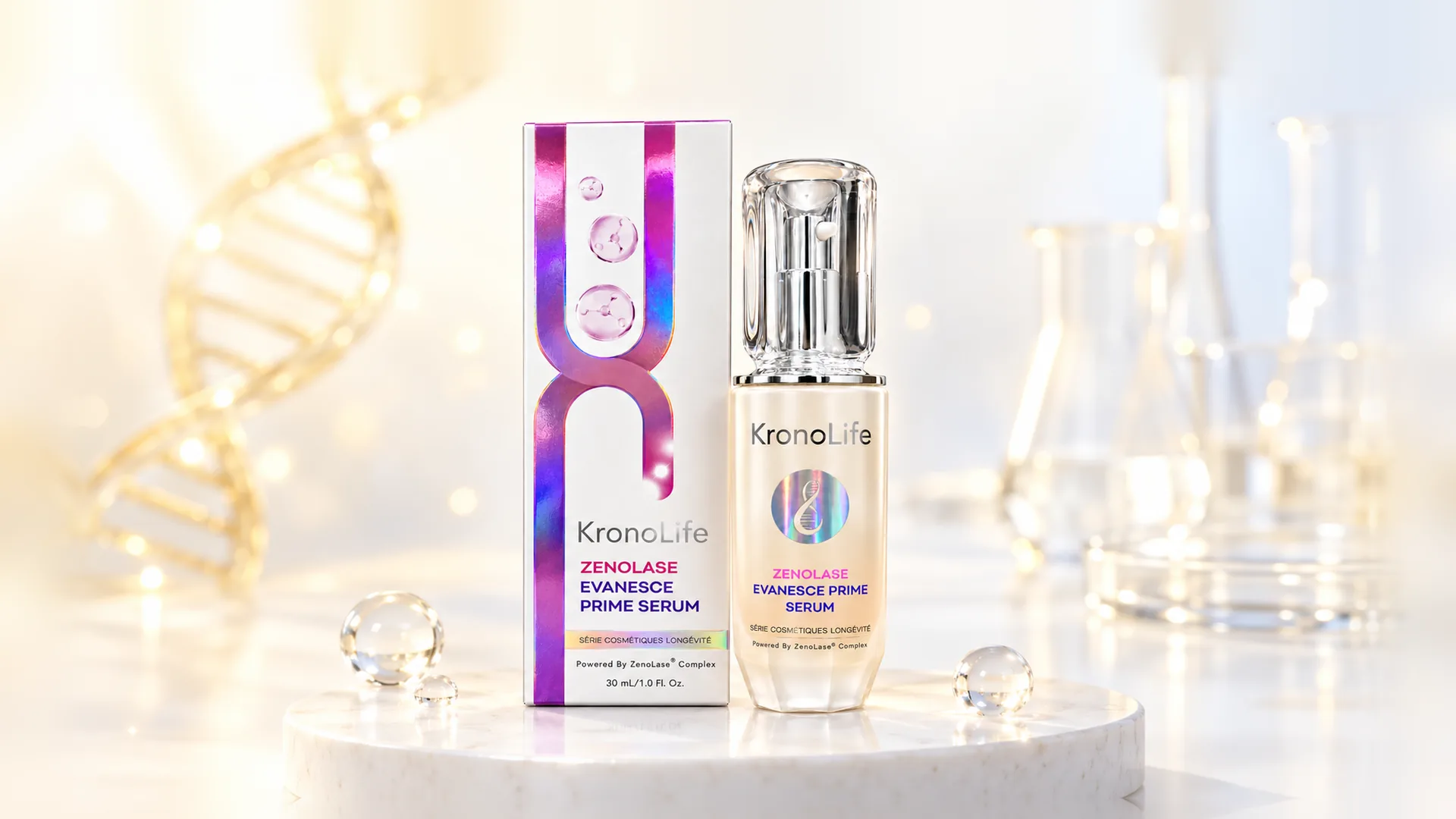
A senolytic serum is a skincare serum built around an active that targets senescent cells, the damaged cells that stop dividing and build up in aging skin. The promise to a formulator is specific: the active in the bottle should act on senescent cells. That promise is easy to print and hard to prove. This case study follows ZenoLase, a senolytic active, and ZenoLase Evanesce Prime Serum, the finished serum built on it, from cell experiments to ex vivo human skin, clinical use testing and the finals of Cosmetic Victories 2023 in Paris.
It is written for R&D managers, brand owners and ingredient buyers who are weighing a senolytic active or planning their own longevity serum. Every number below is KronoLife internal data and is shown with the model it came from. The aim is to show how the evidence was built, where it is strong, where the next questions are, and how partners can use the active.
ZenoLase comes from KronoLife, a longevity biotech startup grown in the research ecosystem of Thailand's National Science and Technology Development Agency (NSTDA). Its co-founder and CEO–CTO, Dr. Tawin Iempridee, holds a Ph.D. in Cancer Biology from the University of Wisconsin–Madison and researches the biology of aging.
Why target senescent cells in aging skin?
Senescent cells are cells that have stopped dividing for good but do not die, and in human skin they build up with age in both the epidermis and the dermis. They are a skincare target because they release inflammatory signals that change the tissue around them.
Cellular senescence is one of the twelve hallmarks of aging described by López-Otín and colleagues.[1] In 1995, Dimri and colleagues showed that a beta-galactosidase detectable at pH 6 marks senescent human cells, and that this marker increases with donor age in dermal fibroblasts and epidermal keratinocytes of human skin.[2] Later work has described senescent cells in both the epidermis and the dermis, with close links to mitochondrial dysfunction and DNA damage.[3]
The problem is not only that these cells stop working. Senescent cells release a mix of inflammatory signals called the senescence-associated secretory phenotype (SASP), which changes the tissue around them.[4] In a progeroid mouse model, genetic removal of p16Ink4a-positive senescent cells delayed the onset of several age-related changes, which made senescent cells a target in their own right.[5]
Researchers then found that senescent cells depend on pro-survival pathways to resist cell death, and identified compounds that selectively kill them. They named this class senolytics.[6] The first senolytics included dasatinib, quercetin, fisetin and navitoclax.[7] Two of these, quercetin and fisetin, are plant flavonoids, and reviews of senotherapeutics now cover both natural and synthetic compounds.[8]
Senolytic skincare borrows the biology of this field. It does not borrow its drug claims. Kirkland and Tchkonia state that senolytic drugs should not be used outside clinical trials until those trials are complete.[7]
A cosmetic senolytic active has a narrower job: show a measurable effect on senescence and related skin markers in credible human-relevant models, and be well tolerated at use level. For the differences between the three main classes, see our guide to senolytics, senomorphics and geroprotectors.
The senolytic active: a high-purity plant extract
ZenoLase is KronoLife's patent-pending senolytic active, made from a high-purity plant extract whose plant source is kept confidential. ZenoLase was characterized in aged human skin cells, ex vivo adult human skin and 3D skin models, and clinically tested for irritation and sensitization.
KronoLife's wider patent portfolio includes a PCT application on a natural senolytic formulation (PCT/TH2025/050028) and further Thai patent and petty patent filings on senolytic and geroprotector compositions.
For a buyer, three properties of a senolytic active matter more than its origin story:
- A defined material. A high-purity extract gives a formulator something specific to dose and to specify. Ask for the specification and batch documents your quality team needs.
- A senolytic effect measured in human tissue. Cell culture shows direction. Human skin tissue shows whether the effect holds in a real tissue structure.
- Data beyond senescence. A skin product is judged on several outcomes at once: matrix (collagen, hyaluronic acid), inflammation, mitochondria and pigmentation.
ZenoLase was characterized on all three fronts. The results below are grouped by model, from the simplest system to the one closest to real use.
What evidence supports the ZenoLase senolytic serum?
The ZenoLase senolytic serum and its active rest on four levels of evidence: aged human skin cells, ex vivo and 3D skin models, clinical safety testing, and clinical use evaluation. In ex vivo human skin, senolytic activity was +255% for the active and +158% for the finished serum, each against its own study control (KronoLife internal data).
KronoLife grades evidence in four levels: (1) mechanism and lab studies, (2) human-relevant models, meaning 3D skin (reconstructed human epidermis and full-thickness models) and ex vivo human skin, (3) safety and compatibility, and (4) human use evaluation. Each level answers a different question, so each result in the table carries its model.
| Evidence level | Material tested | Model | Result |
|---|---|---|---|
| 1. Mechanism / lab | ZenoLase (active) | Aged human skin cells | Mitochondrial protection 60% |
| 2. Human-relevant model | ZenoLase (active) | Ex vivo adult human skin | Senolytic activity +255% vs control |
| 2. Human-relevant model | ZenoLase (active) | Ex vivo adult human skin | Collagen +94%; hyaluronic acid +484% |
| 2. Human-relevant model | ZenoLase (active) | Ex vivo adult human skin | Age-related inflammation −40 to −55% |
| 2. Human-relevant model | ZenoLase (active) | 3D skin model | Melanin −38% |
| 3. Safety | ZenoLase (active) | Clinical testing | Non-irritating, non-sensitizing |
| 2. Human-relevant model | ZenoLase Evanesce Prime Serum | Ex vivo human skin | Senolytic activity +158% |
| 2. Human-relevant model | ZenoLase Evanesce Prime Serum | Ex vivo human skin | Age-related inflammation −50 to −85%; protection against UV, blue light and PM2.5 stressors |
| 2. Human-relevant model | ZenoLase Evanesce Prime Serum | 3D skin model | Telomere length restored 2× vs control |
| 3. Safety | ZenoLase Evanesce Prime Serum | Clinical testing | Non-irritating, hypoallergenic |
| 4. Human use | ZenoLase Evanesce Prime Serum | Clinical use evaluation | Hydration, elasticity, radiance and fine lines improved within 14 days |
How to read the table
- Compare within a row, not across rows. The active (+255%) and the serum (+158%) were tested as different materials, each against the control of its own study. A lower number for the serum does not mean a weaker product. It means a different test.
- Ask how each percentage was calculated. "vs control" needs a definition: which control, which endpoint, and how many skin donors or replicates.
- Ex vivo skin carries the core claims. Ex vivo adult human skin keeps the layered structure and mix of cell types of real skin during the study. That makes it the most informative model in this table for the senolytic, collagen, hyaluronic acid and inflammation readouts.
- Clinical results describe cosmetic outcomes in use. They measure how skin looks and feels. They do not count senescent cells in the volunteers' skin.
The senolytic readout deserves its own question. Senescence in tissue is measured with markers such as senescence-associated beta-galactosidase (SA-β-gal) and p16, and the field has no single universal biomarker for every senescent cell type in skin.[9] Before you compare senolytic numbers from two suppliers, ask which marker was counted, in which cell type, and after how many days. Our guide to the SA-β-gal senescence assay explains the method and its limits.
How was ZenoLase turned into a finished longevity serum?
ZenoLase became a finished longevity serum, ZenoLase Evanesce Prime Serum, by encapsulating the active in Liponiosome nanoparticles, KronoLife's encapsulation system, and adding triplex peptides. Because encapsulation and formulation can change how an active behaves, the finished serum was tested again as a whole formula instead of relying on data from the raw active. The encapsulated form of the active is named EN-ZenoLase.
An active that works in tissue culture still has to reach its target from a bottle. The stratum corneum, the outermost layer of the skin, is a significant barrier to penetration. Vesicle carriers such as niosomes have been studied in cosmetics to improve the stability, controlled release and skin permeation of actives.[10]
Two points stand out for formulators. First, the senolytic signal remained measurable in the finished format (+158% in ex vivo human skin). Second, the serum data added endpoints that the active data did not cover: protection against UV, blue light and PM2.5 stressors, telomere length in a 3D skin model, and clinical skin-quality measures. A finished longevity serum is judged on these outcomes, and they cannot be inferred from the active alone.
What safety data exist for ZenoLase and its serum?
In clinical testing, the ZenoLase senolytic active was non-irritating and non-sensitizing, and the finished ZenoLase Evanesce Prime Serum was non-irritating and hypoallergenic. Thai brand owners and OEM manufacturers often ask for irritation data before production, and any new formula built on ZenoLase needs its own safety screen.
Safety sits at Level 3 of the framework for a reason. A longevity serum is meant for long-term daily use, so tolerance matters as much as efficacy. The scientific framework for longevity cosmeceuticals, with Dr. Tawin Iempridee as senior author, lists comprehensive safety assessment next to clinical validation as a condition for any product described as a longevity cosmeceutical.[11]
On ex vivo human skin, a skin viability study (MTT/LDH, similar in purpose to a non-irritation screen) and a cumulative irritation study (LDH) can be run; timing depends on the markers and models chosen and is set out in the project quotation. KronoLife designs and manages these studies, working with partner laboratories in Thailand.
Paris: Top 3 at Cosmetic Victories 2023
In 2023, ZenoLase was named a Top 3 finalist at Cosmetic Victories (Cosmetic Valley and ESSEC, Paris), and ZenoLase Evanesce Prime Serum, the serum built on the active, is now on the market in Thailand. An award is not efficacy data, and it should not be read as such, but it adds an outside view. The full list of KronoLife's recognitions is on the awards page.
A senolytic active from a Thai research team was presented in Paris and reached the final three. For an ingredient buyer, that is a reason to take a meeting. The decision still rests on the data in the table above.
The development path at a glance
The ZenoLase project moved through six stages: target (senescent cells in skin), active (a high-purity plant extract), human tissue (ex vivo and 3D skin), formula (Liponiosome encapsulation plus triplex peptides), safety and use (clinical testing), and market (Top 3 in Paris, the serum on the Thai market, the active open to partners).
- Target Senescent cells and the age-related inflammation linked to them in skin.
- Active A high-purity plant extract, with mitochondrial protection measured in aged human skin cells.
- Human tissue Senolytic activity, collagen, hyaluronic acid and inflammation measured in ex vivo adult human skin; melanin in 3D skin.
- Formula Liponiosome encapsulation plus triplex peptides, then the finished serum tested again ex vivo and in 3D skin.
- Safety and use Non-irritating in clinical testing; skin-quality outcomes measured within 14 days.
- Market Top 3 at Cosmetic Victories 2023; serum on the Thai market; active open to partners.
What the project shows about building a longevity serum
The ZenoLase project shows five practical rules for building a longevity serum: put the model next to every number, test the finished formula and not only the active, measure more than one hallmark of aging, know where each kind of evidence stops, and plan the studies early.
Put the model next to every number
"+255% senolytic activity" means little on its own. "+255% vs control in ex vivo adult human skin" is a statement an R&D manager can evaluate and a regulatory manager can defend. The same rule protects the brand that later uses the data.
Test the finished formula, not only the active
The serum results differ from the active results, and they add endpoints the active never covered. A brand that prints active-level data on a finished product is making a claim its product has not been tested for.
Measure more than one hallmark
Aging hallmarks are interconnected.[1] The ZenoLase data cover senescence, inflammation, matrix, mitochondria, pigmentation and telomere length. A panel like this shows how one active touches several aging processes, and gives a brand more than one evidence-based story.
Know where each kind of evidence stops
The clinical results reported here cover tolerance and visible skin quality within 14 days. Biomarker evidence comes from the ex vivo and 3D models.
The longevity cosmeceutical framework recommends clinical trials with post-trial skin biopsies to check aging-hallmark biomarkers in human skin.[11] That is the top rung for any longevity claim.
Plan the studies early
Studies such as senolytic activity on ex vivo skin and telomere length in a 3D skin model each need time, and timing depends on the markers and models chosen; it is set out in the project quotation. A brand that wants evidence ready at launch has to start the studies early.
How can brands and ingredient buyers use ZenoLase?
Brands and ingredient buyers can use ZenoLase, KronoLife's patent-pending senolytic active, through one of three partnership models: a license, in which KronoLife keeps the IP; co-development, with joint IP; or transfer and license-back, structured case by case. ZenoLase Evanesce Prime Serum, on the market in Thailand, shows the active in a finished consumer product.
The three partnership models in brief:
- License. KronoLife keeps the IP, and the partner uses the active under license in its own products.
- Co-development. The partner and KronoLife develop a product or format together, with joint IP.
- Transfer and license-back. A transfer arrangement with a license back, structured case by case.
Our article on licensing longevity actives compares the models in more detail, and the KronoLife actives page lists ZenoLase next to ReverZase, DionySenz and KronoZase. To see how the active performs in a finished consumer product, look at ZenoLase Evanesce Prime Serum on the products page.
For a first conversation, bring the product format you have in mind, your target markets, the claims you hope to make and the evidence your regulatory team needs. Those four answers decide which data already exist and which studies a new formula still needs.
What should you ask a senolytic active supplier?
A buyer should ask any senolytic active supplier seven questions, covering the model used, the senescence marker counted, the control and calculation, whether the active was tested alone or in a finished formula, the safety data, the clinical endpoints and duration, and the IP status and partnership models.
- In which model was the senolytic activity measured: cell culture, 3D skin or ex vivo human skin?
- Which senescence marker was counted, in which cell type, and after how many days?
- What was the control, and how was the percentage change calculated?
- Was the active tested alone, in a finished formula, or both?
- What safety data exist for the active, and for a finished product that contains it?
- Which clinical endpoints were measured, over how many days?
- What is the IP status, and which partnership models are open?
A supplier who can answer all seven questions with a model and a number is giving you evidence you can build on. The ZenoLase data in this case study are laid out to answer each of them.
FAQ
What is a senolytic serum?
A senolytic serum is a skincare serum built around an active that targets senescent cells in skin. For a credible product, the senolytic effect should be measured in human-relevant models such as ex vivo human skin, and the finished serum should have its own safety and clinical use data.
Is ZenoLase a drug?
No, ZenoLase is a cosmetic active, not a drug. Its results come from skin models and cosmetic clinical testing, and it makes no disease claims. Senolytic drugs are a separate field that is still in clinical trials.
Which plant is ZenoLase made from?
The plant source of ZenoLase is confidential. ZenoLase is described as a high-purity plant extract, and it is patent pending.
How long does a senolytic activity study on ex vivo human skin take?
Timing depends on the markers and models chosen and is confirmed in the project quotation, so plan the study well before your launch date.
Can we use ZenoLase in our own brand's serum?
Yes. ZenoLase is available through a license, co-development or transfer and license-back.
References
- López-Otín C, Blasco MA, Partridge L, Serrano M, Kroemer G. Hallmarks of aging: An expanding universe. Cell. 2023;186(2):243-278. doi:10.1016/j.cell.2022.11.001
- Dimri GP, Lee X, Basile G, Acosta M, Scott G, Roskelley C, et al. A biomarker that identifies senescent human cells in culture and in aging skin in vivo. Proc Natl Acad Sci U S A. 1995;92(20):9363-9367. doi:10.1073/pnas.92.20.9363
- Ho CY, Dreesen O. Faces of cellular senescence in skin aging. Mech Ageing Dev. 2021;198:111525. doi:10.1016/j.mad.2021.111525
- Coppé JP, Desprez PY, Krtolica A, Campisi J. The senescence-associated secretory phenotype: the dark side of tumor suppression. Annu Rev Pathol. 2010;5:99-118. doi:10.1146/annurev-pathol-121808-102144
- Baker DJ, Wijshake T, Tchkonia T, LeBrasseur NK, Childs BG, van de Sluis B, et al. Clearance of p16Ink4a-positive senescent cells delays ageing-associated disorders. Nature. 2011;479(7372):232-236. doi:10.1038/nature10600
- Zhu Y, Tchkonia T, Pirtskhalava T, Gower AC, Ding H, Giorgadze N, et al. The Achilles' heel of senescent cells: from transcriptome to senolytic drugs. Aging Cell. 2015;14(4):644-658. doi:10.1111/acel.12344
- Kirkland JL, Tchkonia T. Senolytic drugs: from discovery to translation. J Intern Med. 2020;288(5):518-536. doi:10.1111/joim.13141
- Lagoumtzi SM, Chondrogianni N. Senolytics and senomorphics: Natural and synthetic therapeutics in the treatment of aging and chronic diseases. Free Radic Biol Med. 2021;171:169-190. doi:10.1016/j.freeradbiomed.2021.05.003
- Wang AS, Dreesen O. Biomarkers of cellular senescence and skin aging. Front Genet. 2018;9:247. doi:10.3389/fgene.2018.00247
- Abu-Huwaij R, Alkarawi A, Salman D, Alkarawi F. Exploring the use of niosomes in cosmetics for efficient dermal drug delivery. Pharm Dev Technol. 2023;28(7):708-718. doi:10.1080/10837450.2023.2233613
- Klinngam W, Chaiwichien A, Osotprasit S, Ruktanonchai U, Kanlayavattanakul M, Lourith N, Wongrakpanich A, Teeranachaideekul V, Iempridee T. Longevity cosmeceuticals as the next frontier in cosmetic innovation: a scientific framework for substantiating product claims. Front Aging. 2025;6:1586999. doi:10.3389/fragi.2025.1586999
Longevity actives
Evaluate a patented longevity active
Ask for the technical dossier of ZenoLase, ReverZase, DionySenz or KronoZase: mechanism, efficacy by model, safety and recommended use level.

About KronoLife's scientific lead
Dr. Tawin Iempridee is Co-Founder and CEO–CTO of KronoLife, with a Ph.D. in Cancer Biology from the University of Wisconsin–Madison and a research focus on the biology of aging. Dr. Tawin has 25+ international publications and 17+ IP filings, and is senior author of a 2025 framework for substantiating longevity cosmeceutical claims.
About KronoLifeRelated reading
Senolytics, Senomorphics and Geroprotectors: A Formulator's Guide
Three classes of longevity actives act on aging biology in different ways. This guide explains how each works, what changes when research drugs become consumer products, and how to choose a class for a brief.
Read the article
Senescent Cells in Skin Aging: What R&D Teams Need to Know
Cellular senescence links UV, DNA damage and time to collagen loss, chronic inflammation and uneven pigment. This guide covers the biology, the human-skin evidence, and what it means for actives, endpoints and claims.
Read the articleNatural Senolytics: Plant Compounds and the Evidence Behind Them
Fisetin, quercetin, procyanidin C1 and other plant compounds can clear senescent cells in the lab. This article grades the evidence for each and sets out what a botanical needs before it becomes a validated skin active.
Read the article